
HEAPOW logo


SAX/Aql X-1
Credit: S. Campana, Brera Observatory, Milano-Merate

The Fall of Aquila X-1

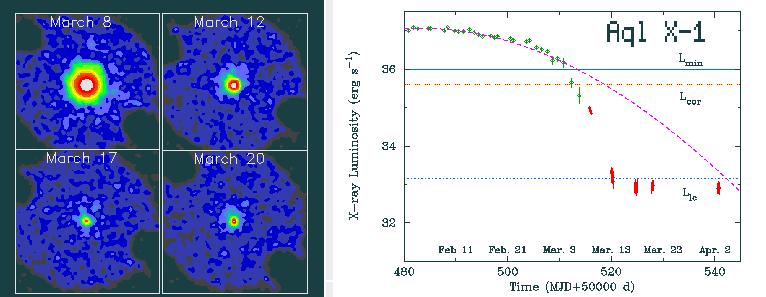
Objects called "Soft X-ray Transients" are composed of some type of compact object (probably a neutron star) and some type of "normal", low mass star (i.e. a star with a mass of some fraction of the Sun's mass). These objects show changing levels of low-energy, or "soft", X-ray emission, probably produced somehow by variable transfer of mass from the normal star to the compact object. In effect the compact object "gobbles up" the normal star, and the X-ray emission can provide the best view of how this process occurs. But because these objects vary it's difficult to catch them at crucial times. In February 1997 a soft X-ray transient in the constellation of Aquila known as Aql X-1 was detected in outburst by the Rossi X-ray Timing Explorer. RXTE followed the slow decline from X-ray maximum; but when the RXTE observations ended the story was still not complete, since the star had not reached its normal "quiescent" level. This important gap was filled in by the BeppoSAX X-ray satellite, which started to observe Aql X-1 at the end of the RXTE observations. The image on the right shows the decline from X-ray maximum as seen by RXTE (green points) and BeppoSAX (red points). RXTE clearly shows a rather smooth decline though the last two data points do not follow the smooth decline but seem fainter than astronomers would have predicted. The BeppoSAX observations confirm the RXTE results and show that the decline to quiescence occurs much more rapidly than expected. The image on the left shows BeppoSAX images detailing the change in brightness of Aql X-1 through March 1997.

Last Last Week Dictionary HEA Dictionary Archive Archive search Search HEAPOW education Education tomorrow Next Week


Each week the HEASARC brings you new, exciting and beautiful images from X-ray and Gamma ray astronomy. Check back each week and be sure to check out the HEAPOW archive!
 

Page Author: Dr. Michael F. Corcoran
Last modified October 8, 2001


Space Science Data System
Cosmic Journeys
Part of the NASA OSS
Structure and Evolution of the Universe theme.

Questions/Comments/Feedback
Tell me about black holes, astronomy, and more!

NASA Security and Privacy Statement

A service of the Laboratory for High Energy Astrophysics (LHEA) at NASA/GSFC
and the High Energy Astrophysics Division of the Smithsonian Astrophysical Observatory (SAO) 

HEASARC Director: Dr. Nicholas E. White,
white@adhoc.gsfc.nasa.gov
HEASARC Associate Director: Dr. Steve Murray, ssm@head-cfa.harvard.edu
Technical Representative: Eunice Eng, 
eunice.eng@gsfc.nasa.gov