 |
OSSERVATORIO ASTRONOMICO DI BRERA
|
| OAB
Highlights
Latest results in the OAB research and/or technological activity along with a brief explanation. |
An XMM-Newton study of the 401
Hz accreting pulsar
SAX J1808.4-3658 in quiescence
SAX J1808.4-3658 is a unique source being the first
Low Mass X-ray Binary showing coherent pulsations at a spin period comparable
to that of millisecond radio pulsars.
XMM-Newton observation of SAX J1808.4-3658 in quiescence
were the first which assessed its quiescent luminosity and spectrum with
good signal to noise. XMM-Newton did not reveal other sources in the vicinity
of SAX J1808.4-3658 likely indicating that the source was also detected
by previous BeppoSAX and ASCA observations, even if with large positional
and flux uncertainties. We derive a 0.5-10 keV unabsorbed luminosity of
LX=5x1031 erg s-1 a relatively low value
compared with other neutron star soft X-ray transient sources. At variance
with other soft X-ray transients, the quiescent spectrum of SAX J1808.4-3658
was dominated by a hard (Gamma ~ 1.5) power law with only a minor contribution
(< 10%) from a soft black body component. If the power law originates
in the shock between the wind of a turned-on radio pulsar and matter outflowing
from the companion, then a spin-down to X-ray luminosity conversion efficiency
of ~ 10-3 is derived; this is in line with the value estimated
from the eclipsing radio pulsar PSR J1740-5340. Within the deep crustal
heating model, the faintness of the blackbody-like component indicates
that SAX J1808.4-3658 likely hosts a massive neutron
star (M>1.7 Mo). This is the first evidence for massive
neutron stars in Low Mass X-ray Binary systems.
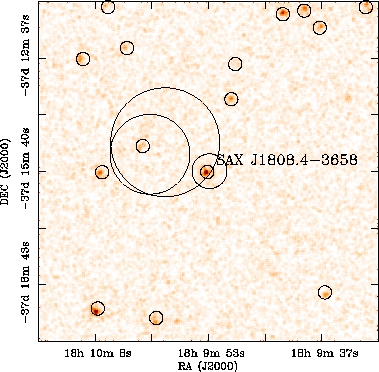
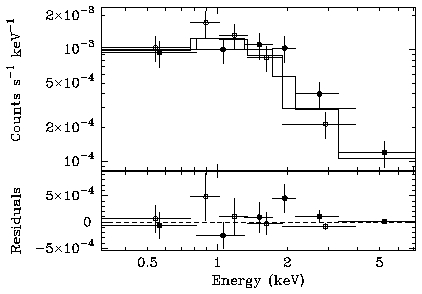
Left panel: XMM-Newton image of SAX J1808.4-3658. Small
circles refer to XMM-Newton sources; large circles to previous positions
of SAX J1808.4-3658 obtained with BeppoSAX and ASCA. Right panel:
XMM-Newton MOS1 (filled circles) and MOS2 (open circles) spectrum
of SAX J1808.4-3658 with only a power law component.
For more information about this discovery, refer to
http://babbage.sissa.it/abs/astro-ph/0206376
| OAB Highlights Index |