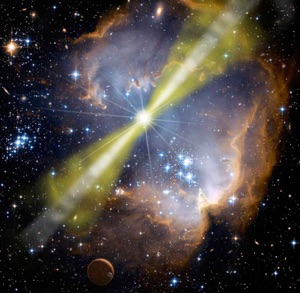
Since the discovery of GRBs in the late ’60 untill 1997 we have been studying the properties of these sources in the observer frame. Starting in 1997 with the measurement of their distances we could study their rest frame properties (energetics and luminosities).
However, GRBs are relativistic sources: the radiation we see is blue-shifted and the luminosity is enhanced by the large velocities of the relativistically expanding plasma.
The step forward to understand GRBs is to study their comoving frame properties, i.e. by computing their energetics and characteristic spectral properties accounting for the relativistic effects present in these sources.
In a systematic study we have collected GRBs showing an early peak in their optical afterglow light curve. This allows us to estimate the bulk Lorentz factor Γ0 of the ejecta from the time of the afterglow peak.
Applying relativistic corrections we find that:
-
2)The Γ0 factors correlate with the luminosity and the peak energy of GRBs and these newly found correlations provide an interpretation of the spectral-energy correlations of GRBs.
-
3)The product of the bulk Lorentz factor and the jet opening angle Γ0 ϑ ranges between 5 and 20, in agreement with recent simulations of magnetically accelerated jet models. (picture)